
Maine & New Hampshire roofing
How Long Do Asphalt Shingle Roofs Last in Maine?
By Roof Vital··6 min read
Asphalt shingle manufacturers print numbers like 25, 30, or even 50 years on their warranties, but those figures assume controlled lab conditions that don't exist on a real Maine roof. In practice, asphalt shingle roofs in Portland, Scarborough, Windham, and the rest of southern and central Maine tend to show real wear somewhere between 15 and 25 years, and that range is wide because the variables that drive aging vary enormously from house to house.
Two roofs installed the same year, on similar homes a few miles apart, can age at noticeably different rates. One might still look tight and serviceable at 18 years while the other is losing granules and curling at 14. The difference usually comes down to a handful of factors: how much freeze-thaw cycling the roof deck goes through, how well the attic is ventilated, which direction the roof faces, how the roof was installed, and the quality of the shingle itself.
This article walks through each of those factors so you can understand where your own roof likely falls in that range, rather than relying on a generic number that may not apply to your house at all.
Why there's no single lifespan number for Maine roofs
Manufacturer warranty ratings are tested under standardized conditions, not New England winters. Maine roofs deal with repeated freeze-thaw cycling, ice damming, wind-driven precipitation, and UV exposure that swings from intense summer sun to months of snow cover. That combination of stressors doesn't show up uniformly. A roof's actual service life depends on the specific conditions it experiences and how it was built and maintained, not on a printed warranty term.
Freeze-thaw cycling and its effect on shingles
Maine typically goes through dozens of freeze-thaw cycles each winter. Water that gets under or into a shingle's surface, or into small cracks in aging asphalt, expands when it freezes and contracts as it thaws. Repeated over years, this cycle accelerates granule loss and can worsen existing cracking in the shingle mat. Roofs that have gone through 15 or 20 Maine winters have absorbed a lot more of this stress than a similarly aged roof in a milder climate.
Snow load and ice damming
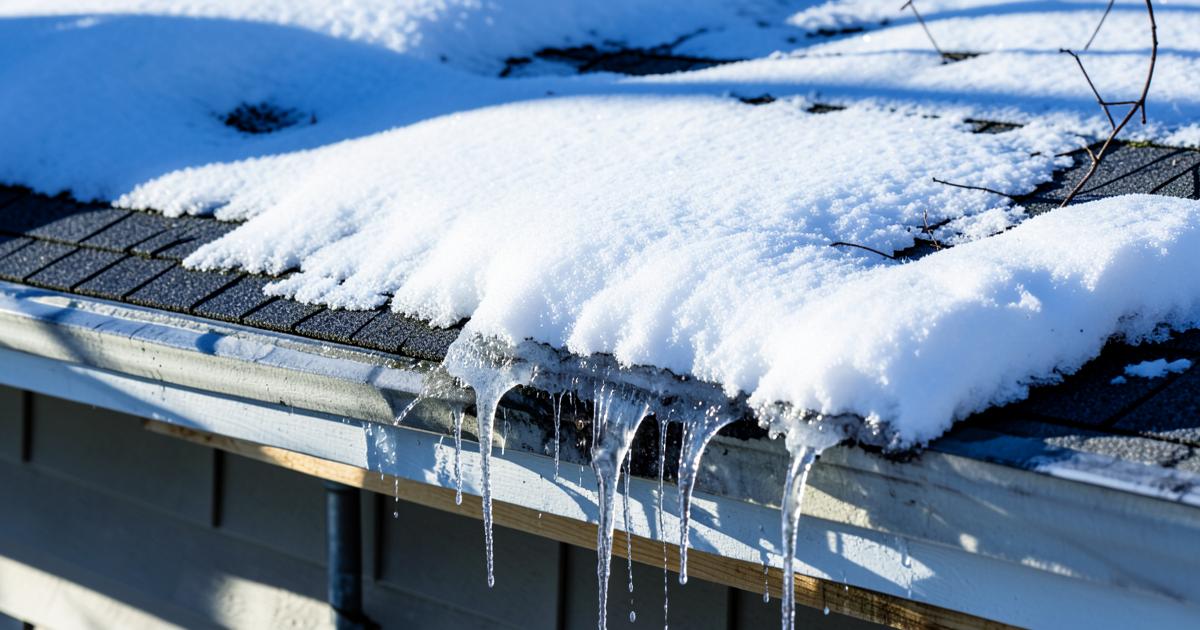
Heavy, wet snow adds sustained weight to a roof deck, and when snow melts unevenly near the eaves and refreezes at the roof edge, it can form ice dams. Ice dams force water backward under the shingle line instead of letting it drain off the roof, which is a common cause of leaks that have nothing to do with the shingles' overall age. Roofs with poor attic insulation or ventilation are especially prone to this pattern, because heat escaping into the attic melts snow unevenly across the roof surface.
Wind exposure
Coastal and open-lot homes in places like Old Orchard Beach, Freeport, or Scarborough can see stronger, more consistent wind loading than sheltered inland lots. Wind doesn't just risk lifting shingles in a single storm; sustained exposure over years can loosen sealant strips and edge shingles gradually, making that section of roof more vulnerable to future wind and water intrusion.
UV exposure and roof orientation
Asphalt shingles age faster on south- and west-facing slopes, which absorb more direct sun over the course of a year. It's common to see a visible difference in granule loss and color fading between a home's south slope and its shaded north slope, even though both sections are the same age and were installed at the same time. UV breaks down the asphalt binder in the shingle over time, and that process runs faster wherever sun exposure is highest.
Moisture and attic ventilation
Ventilation is one of the biggest, and most overlooked, factors in shingle lifespan. An attic that can't exhaust heat and moisture properly bakes the underside of the roof deck in summer and traps condensation in winter. Both shorten shingle life from below, independent of anything happening on the roof's surface. Homes with balanced intake and exhaust ventilation, working in tandem with proper insulation, consistently hold up better over time than homes without it.
Installation quality
Even a premium shingle underperforms if it's installed with incorrect nailing patterns, inadequate underlayment, poor flashing details around chimneys and valleys, or insufficient starter strip coverage at the eaves. Installation defects tend to show up as localized problems — a leak at one valley, lifting at one edge — well before the rest of the roof shows its age. This is part of why two houses with identical shingles can age so differently.
Shingle quality and product tier
| Shingle tier | Typical construction | General real-world pattern in Maine |
|---|---|---|
| Economy 3-tab | Thinner mat, lighter granule coverage | Tends to show wear earliest, especially on sun-exposed slopes |
| Mid-grade architectural/laminate | Heavier mat, dimensional layers | Common on Maine homes; performance varies widely with installation and ventilation |
| Premium/designer laminate | Thickest mat, denser granule coverage | Generally more resistant to curling and granule loss, but still depends on the same climate and ventilation factors |
This reflects general industry patterns, not a guarantee for any specific product or roof.
What this means for your own roof
If your roof is somewhere in the middle of its expected life, say 12 to 18 years old, condition matters more than the calendar. Some roofs in that range are still structurally sound with intact shingles and are reasonable candidates for maintenance measures that extend service life. Others have already lost enough granule coverage or flexibility that they're closer to needing full replacement. The only way to tell which category your roof falls into is a hands-on look at the actual shingles, not a guess based on installation year.
Key takeaways
- Manufacturer warranty years don't reflect real-world Maine conditions.
- Freeze-thaw cycling, snow load, and ice damming are climate-specific stresses that accelerate wear.
- South- and west-facing slopes typically age faster than shaded slopes on the same roof.
- Attic ventilation affects shingle life from underneath, independent of surface exposure.
- Installation quality and shingle tier both shape how a roof actually performs over time.
- The only reliable way to know your roof's real condition is a physical inspection.
Frequently asked questions
Is 20 years old for an asphalt roof in Maine?
It's within the range where condition varies a lot from roof to roof. Some 20-year-old roofs in Maine are still sound; others have already lost significant granule coverage or flexibility. Age alone isn't a reliable indicator either way.
Do south-facing roofs really age faster?
Generally, yes. South- and west-facing slopes get more direct UV exposure over the course of a year, which accelerates the breakdown of the asphalt binder in the shingle compared to shaded slopes on the same roof.
Does snow shorten a roof's life?
Heavy snow load itself is usually less of an issue than the ice damming that can form when snow melts unevenly. Ice dams push water back under the shingle line and can cause leaks unrelated to the shingles' overall age.
Can better ventilation extend a roof's life?
Ventilation affects how much heat and moisture build up under the roof deck, which influences shingle aging from below. It's one of several factors, along with installation quality and shingle grade, that shape long-term performance.
How do I find out how much life is left in my roof?
A physical inspection is the only reliable method. It looks at granule loss, shingle flexibility, flashing condition, and the roof deck to give you an honest read on where your specific roof stands.
Not sure where your roof stands?
An inspection gives you a straight answer on your roof's actual condition, not a generic age estimate.
See if your roof qualifiesAbout the author
Roof Vital
Roof rejuvenation specialists, Portland, Maine
Roof Vital assesses aging asphalt shingle roofs across Southern Maine, Central Maine and Southern New Hampshire, and recommends rejuvenation only where the roof's condition supports it. Articles here are written and reviewed by the Roof Vital team.
More about Roof Vital →